Get ready to explore the wormhole! Learn 5 incredible facts about interstellar travel with our Wormhole Visualizer and NASA-inspired guide.
The Science of Wormholes From Theory to Reality
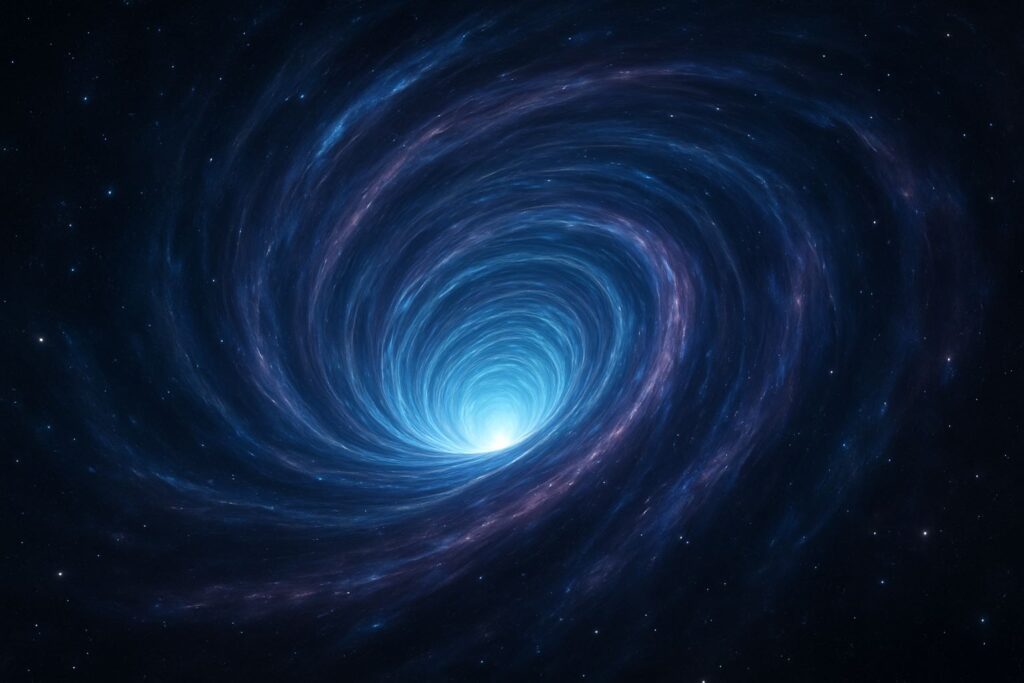
A wormhole Space is a hypothetical tunnel through spacetime, predicted by Albert Einstein theory of general relativity. It provides a shortcut, connecting two distant points in the universe and potentially allowing for faster-than-light travel. While a common trope in science fiction, wormholes represent a valid theoretical solution to the cosmic challenge of immense distances. The core idea is simple if you fold space and time, you can create a direct path between points that would otherwise take millions of years to reach.
The Search for Wormholes and Exotic Matter
So, if wormholes exist in theory, why haven’t we found one? The answer lies in the incredible physics required to create and sustain them. To keep a wormhole open, a special type of substance called “exotic matter” would be needed. This matter would have negative mass or energy, counteracting the immense gravitational forces that would otherwise cause the wormhole to collapse instantly. NASA and other space agencies study gravitational anomalies and phenomena in the deep cosmos, constantly searching for any evidence of these structures or the exotic matter needed to support them.
The Role of NASA and Observational Astronomy
Scientists believe that if wormholes exist, they would be incredibly small and highly unstable. Therefore, their detection would likely require a significant leap in our observational capabilities. NASA advanced telescopes, such as the James Webb Space Telescope, are helping us look deeper into space than ever before, providing invaluable data that could one day reveal clues to these cosmic phenomena. The research into wormholes is a journey of theoretical physics, driven by the desire to understand the universe in all its complexity.
What Exactly Lies Beyond the Heliosphere?
The heliosphere is the protective bubble created by our Sun’s solar wind. Traveling beyond the heliosphere means leaving the Sun direct influence and venturing into true interstellar space. This region is a cold, dark, and mostly empty expanse where the laws of physics as we know them are put to the ultimate test. It’s in this region, far from any star system, that wormholes are theorized to be most likely to exist, away from the gravitational clutter of galaxies.
Unpacking Interstellar Cosmic Phenomena
The movie Interstellar is a masterpiece of science fiction that brought concepts like time dilation and black holes to the mainstream. The film’s scientific advisor, Kip Thorne, ensured that the visual effects were based on real physics.
Black Holes and Time Dilation in the Movie
The film’s depiction of the supermassive black hole Gargantua is one of the most accurate ever created for a movie. It shows how gravity can bend light and warp spacetime. This warping leads to time dilation, where a trip lasting just a few hours near the black hole resulted in decades passing on Earth. This powerful visual is not just a plot device; it’s a stunning example of Einstein’s theory in action.
Experience Your Own Interstellar Journey
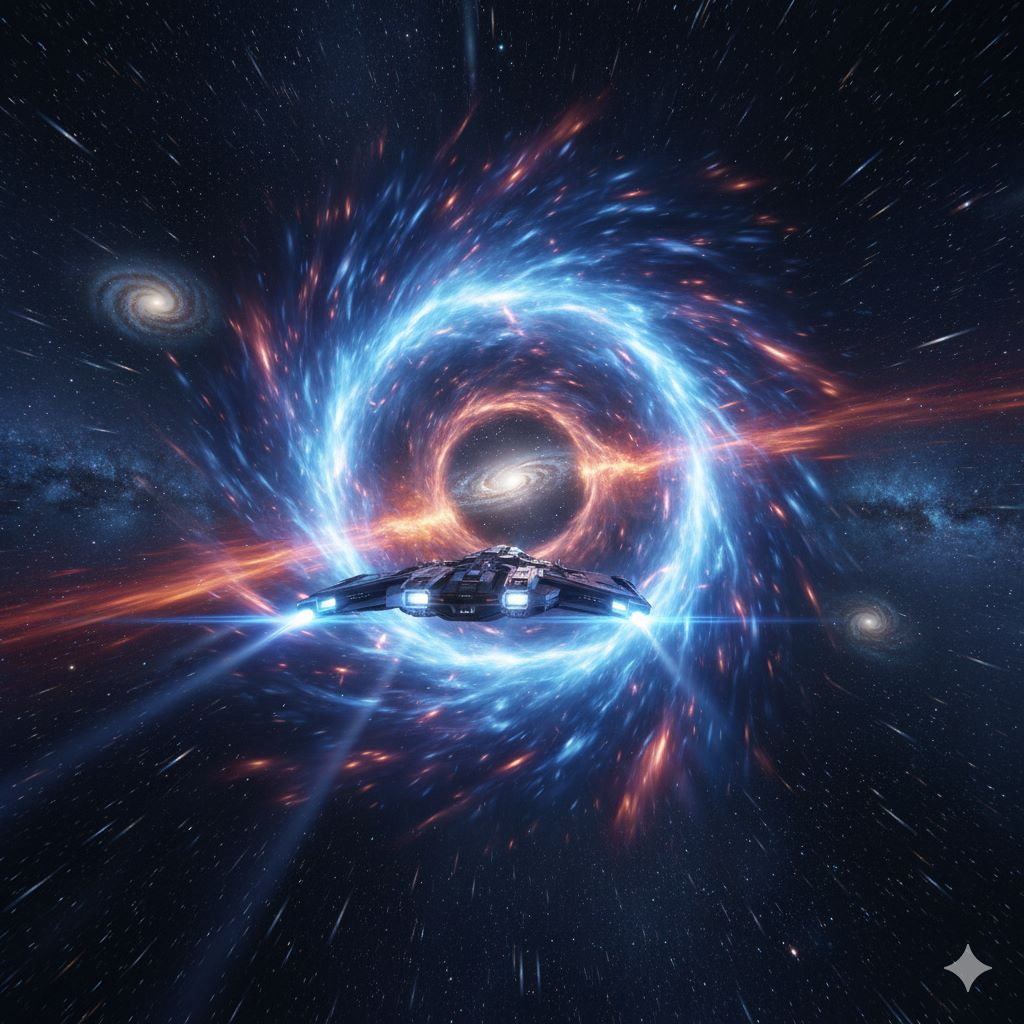
While real-world interstellar travel is still a dream, our Wormhole Website Visualizer offers a chance to experience the wonder of a cosmic shortcut. This NASA-inspired tool puts you in control of an exciting space journey. It’s the perfect way to explore complex concepts in a fun, interactive format.
Start your journey here and explore the ultimate wormhole guide!
| Concept | As Depicted in Sci-Fi (Movie) | Real-World Science |
|---|---|---|
| Wormhole Travel | Instantaneous travel across galaxies. | Hypothetical; requires exotic matter. |
| Time Dilation | One hour near a black hole equals years on Earth. | A proven effect, but on a much smaller scale. |
| Black Holes | Can act as gateways to other dimensions. | A region of immense gravity from which nothing can escape. |
FAQ
What is the biggest challenge to human interstellar travel using a wormhole?
The biggest challenge is not building the wormhole itself, but stabilizing it. In theory, a wormhole would be incredibly small and would collapse faster than light can cross it.
To hold it open for a spaceship, a massive amount of “exotic matter” with negative energy would be needed, a substance that has never been observed or created.
Could we ever build a wormhole with today technology?
No, creating a wormhole is currently far beyond our technological capabilities. The amount of energy required to warp spacetime is astronomical, likely exceeding the energy of all the stars in our galaxy. Furthermore, we don’t know how to produce or handle the exotic matter needed to keep it open.
What are the real-world effects of time dilation that we have already observed?
Time dilation is a very real effect. We see it in action every day with GPS satellites. The satellites are moving at high speeds and are in a weaker gravitational field than we are on Earth. Without constant adjustments to account for time dilation, a GPS system would quickly become inaccurate, showing our location miles away from where we actually are.
How does the wormhole in Interstellar compare to what scientists think they might look like?
The wormhole depicted in Interstellar is one of the most scientifically accurate representations ever seen in a movie. It was designed with the help of physicist Kip Thorne, who used Einstein’s equations to create a visually stunning and physically plausible model. While a real wormhole might not have the dramatic, glowing “mouths” seen in the film, its effects on light and spacetime would be similar to what was shown.